Sacred and Sensual: My Relationship with Tantra, How it Shaped Me as a Naked Yoga Teacher, Bodyworker, and Spiritual Woman.

Find your Sensual Chakra with Mel
By Yoga Goddess Mel
There comes a point when you stop being interested in spirituality that only lives in language.
You can feel the difference. Some things sound beautiful when they are spoken or written, but they never really enter your life. They stay conceptual. They stay decorative. They stay up in the mind where everything can be named and arranged and admired, but nothing actually changes. At some point, that stops being enough. You want something that touches the way you move through the world. You want it to reach your body, your relationships, your grief, your pleasure, your healing, your choices, your capacity to love, and the parts of you that feel half-guarded even when everything looks polished from the outside.
That is what tantra became for me.
It was much quieter than that, and much more intimate. It felt like returning to a part of myself I had known before life taught me to separate everything into categories. Spirit over here. Body over there. Devotion in one room. Desire in another. Grace in one moment. Hunger in another. Tantra dissolved that split in me. It brought me back to the understanding that the body is not some lesser thing to transcend on the way to something holy. The body is part of the holy experience. It is where truth registers. It is where memory lives. It is where longing speaks. It is where life arrives first.
That changed me more than I can fully explain.
I think many women learn to become highly skilled at leaving themselves while still appearing fully present. We learn how to be beautiful, capable, productive, generous, warm, and composed even when we are not really inside ourselves. We learn how to override discomfort. We learn how to shape ourselves into something acceptable and call that self-knowledge. We learn how to stay functional while slowly becoming less sensitive to what the body has been trying to communicate for years.

Help Mel slip into that mind-body connection with deep hip stretching
What tantra gave me was not some abstract philosophy. It gave me a way back into direct relationship with myself.
That relationship changed the way I move, the way I teach, the way I touch, the way I listen, and the way I understand what healing actually is. It changed the standard I hold for truth. It changed the way I think about sensuality. It changed the way I experience devotion. More than anything, it made me less interested in appearances and more interested in what is real enough to be felt.
That matters to me.
For a long time, I think the body was something many of us were taught to manage before we were ever taught to inhabit it. We were taught how to improve it, discipline it, conceal it, display it, tone it, present it, and evaluate it. Even in wellness spaces, there is often so much hidden control disguised as care. Beneath all the language about health and balance, there can still be an old habit of domination. Make the body behave. Make it beautiful. Make it desirable. Make it productive. Make it fit the picture.
But the body is not a prop, and it is not a branding problem. It is not something that exists to be managed into perfection. It is the place where our life is happening.
That was one of the deepest shifts for me. I stopped relating to my body as something I was supposed to fix and began relating to it as something I was supposed to know.

Bella knows how to move the body in a way that feels liberating in Secret Seduction
Now when I move, I am paying attention in a completely different way. I am not only interested in the external result. I care about what is happening underneath the pose, underneath the stretch, underneath the choreography of being “well.” I notice where I am bracing. I notice where I am withholding. I notice what feels guarded and what is beginning to soften. I notice where there is vanity and where there is truth. I notice when I am trying to perform my way through an experience and when I am actually inside it.
That kind of listening has made me much more honest.
It has also changed the way I teach yoga. I am not especially interested in movement that is only impressive from the outside. Beautiful shapes can be lovely, but they are not the point for me. What I care about is whether a practice helps someone become more available to themselves. Does it create more intimacy with breath? Does it make room for sensation instead of shutting it down? Does it allow someone to notice where they have abandoned themselves? Does it help them come back?
That is a different kind of teaching.
I want movement to feel like an entrance, not an achievement. I want someone to leave a class feeling more connected to their body, not more alienated from it because they couldn’t perform a shape perfectly. I want breath to feel like a form of permission. I want strength to feel embodied, not armored. I want softness to feel luxurious rather than weak. I want the whole experience to remind someone that their body is not in the way of their spiritual life, their emotional life, or their sensual life. It is part of all of it.
That same understanding has shaped the way I relate to touch.
Touch, to me, has never been casual. It is never mechanical. The body responds to far more than pressure and technique. It responds to intention. It responds to presence. It responds to whether the person touching it is actually there. A hand can communicate safety. It can communicate care. It can communicate patience. It can communicate, without a single word, that someone does not need to hold themselves together quite so tightly for one moment.
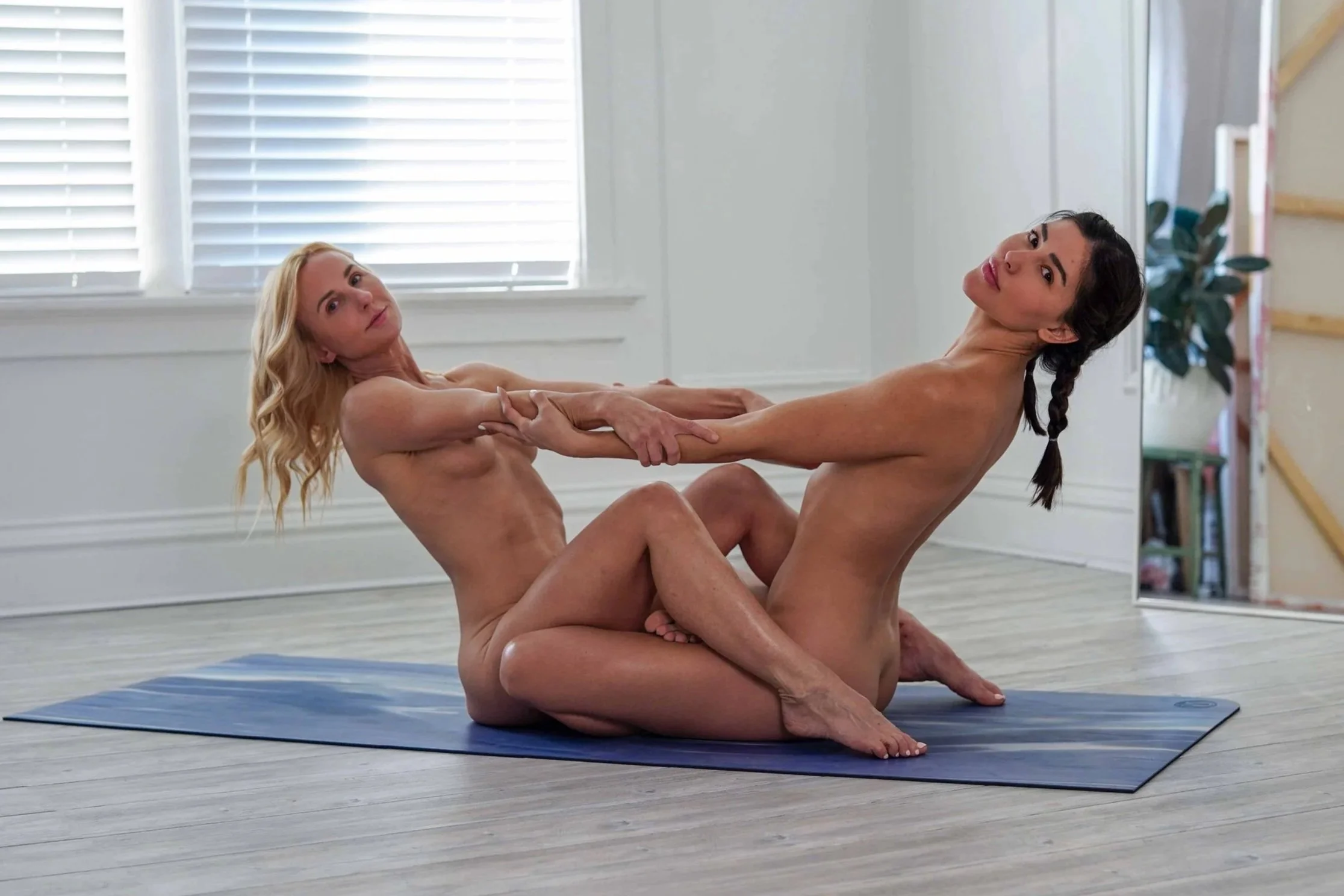
Audri and Asana understand touch as a way of deepening presence and connection
That matters because so many people are living in bodies that have had to become vigilant. They are used to overriding signals, tightening against feeling, smiling through fatigue, and functioning through pain. When a body has been living like that for a long time, healing is not always about doing more to it. Sometimes it begins when there is finally enough safety for something to unclench.
That is one of the reasons reverence has become so important to me. Not as a performance of softness, but as a real quality of presence. Reverence changes the atmosphere. Reverence slows you down. Reverence makes you notice. Reverence refuses to treat the body like an object. It asks you to meet what is in front of you with care and honesty.
That has influenced the way I understand healing more generally too. I do not believe healing is always dramatic. I do not think it is always cathartic, intense, or obvious in the moment. Sometimes it happens because someone finally tells the truth about what they feel. Sometimes it happens because the nervous system experiences a moment it can trust. Sometimes it happens because something guarded is no longer being forced open and can soften on its own.
There is something incredibly sensual about that kind of trust, and I mean sensual in the truest sense of the word.
Sensuality has become one of the most meaningful parts of this conversation for me because it is so often reduced to image. People still tend to interpret sensuality as something external, something ornamental, something designed to be consumed. But that version of sensuality is thin. It may be visually attractive, but it does not necessarily have depth. Real sensuality, the kind that changes a woman from the inside out, comes from being deeply connected to her own experience. It comes from inhabiting herself fully enough to feel what is real.
To me, sensuality is not primarily about looking seductive. It is about being responsive. It is about being alive to texture, rhythm, breath, atmosphere, desire, beauty, and instinct. It is about noticing when your body opens and when it contracts. It is about knowing the difference between performance and actual pleasure. It is about becoming so familiar with your own inner signals that self-betrayal becomes harder and truth becomes more elegant.
That kind of sensuality is inseparable from spirituality in my world. It brings me closer to what is sacred because it asks me to become more awake, not less embodied. It asks for honesty. It asks for presence. It asks me to stop editing myself into something more digestible and instead become more deeply available to what is here.
I think that is part of why tantra has felt so healing for me as a woman. It has given me permission to stop splitting myself into acceptable fragments.
There was a time when I think many of us were quietly taught that to be spiritual we had to become more contained, more disembodied, more palatable, less complex. There was also a parallel message that to be sensual we had to become more visual, more performative, more consumable. Neither one interested me in the end. They both felt like distortions. They both required a kind of self-editing that eventually becomes exhausting.
What felt more honest was allowing all of me to exist in the same room.
The part of me that loves beauty.
The part of me that wants touch to mean something.
The part of me that is discerning.
The part of me that is soft.
The part of me that is powerful.
The part of me that is devotional.
The part of me that is still learning.
The part of me that is deeply feeling and not always interested in pretending otherwise.

Mel reminds us that embracing all parts of ourselves, through all of our different stages of life, is a part of the Tantric practice
When those parts no longer feel like contradictions, something settles. You stop spending so much energy managing your image and start becoming more magnetic in a way that has nothing to do with trying. There is a kind of elegance that appears when a woman is no longer fighting her own nature.
That elegance is deeply connected to devotion for me.
Devotion is one of those words that can sound abstract until it becomes embodied in ordinary life. Then it becomes one of the most intimate things there is. Devotion is in the way I prepare a room. It is in the attention I bring to breath. It is in the care I bring to someone’s body. It is in the way I refuse to rush what wants slowness. It is in the way I notice when I have drifted from myself and choose to return with tenderness rather than punishment.
That quality has changed my life far more than discipline ever did.
Discipline can be useful, of course, but devotion has warmth. It has love in it. It has reverence. It allows beauty to matter. It allows sensuality to matter. It understands that the atmosphere around a practice changes the practice itself. The candle matters. The music matters. The fabric matters. The breath matters. The pacing matters. The mood matters. None of that is shallow to me. It is part of how we create conditions for presence.
When I say tantra shaped me, this is part of what I mean. It taught me that presence is not only mental attention. Presence is relational. Presence is atmospheric. Presence includes the body, the senses, the emotional field, and the subtle feeling of whether something is true.
That understanding also changed the way I relate to femininity.
I have no interest anymore in flattening femininity into one acceptable expression. It is much too rich for that. Femininity can be tender, but it can also be exacting. It can be soft and still have standards. It can be sensual and spiritually serious at the same time. It can be nurturing and unapologetic. It can be composed on the surface and wildly alive underneath. It can be glamorous without being empty. It can be deeply embodied without being reduced to the body.
I think one of the most healing things a woman can experience is the end of that internal war where she feels pressured to choose between being respected and being desirable, between being soulful and being erotic, between being elegant and being fully alive. I do not believe those things need to be separated. I think that separation has made many women smaller than they really are.
This path helped me stop shrinking in that way.
It helped me trust that depth and beauty belong together. It helped me trust that devotion and desire can live in the same body without cancelling each other out. It helped me become less apologetic about the fact that I care about beauty, atmosphere, sensuality, truth, and the sacred all at once. To me, that is not confusion. That is wholeness.
And wholeness is far more interesting than perfection.
Perfection is brittle. It is sterile. It usually asks for performance. Wholeness is textured. It has mystery in it. It has contradictions that are not really contradictions once you understand the full picture. It allows a woman to be honest. It allows her to be glamorous and grieving, powerful and soft, discerning and deeply open. It allows her to be a body and a soul at the same time, which should never have been radical, but somehow still is.
At the center of all of this is a very simple truth. I do not want a spiritual path that asks me to leave myself behind. I do not want one that rewards disconnection and calls it transcendence. I do not want one that makes the body feel like an inconvenience. I want a path that brings me closer. Closer to my body, closer to love, closer to truth, closer to God, closer to the parts of myself that still need tenderness, and closer to the pulse of life as it is actually being lived.
That is what tantra has given me.
It has given me a more intimate relationship with reality. It has made me slower in the best way. More discerning. More embodied. More reverent. More willing to feel. More interested in what is true than in what is impressive. More capable of noticing when I am present and when I am pretending to be.
It has reminded me that the body is not something to be embarrassed by or conquered. It is not something to disconnect from until we become more acceptable, more spiritual, or more healed. It is one of the places where healing begins. It is one of the places where love becomes tangible. It is one of the places where the divine can be felt with startling intimacy.

Cleanse your Root Chakra with Mel
So when I speak about this work, I am not speaking from some polished place of mastery. I am speaking as a woman who has been changed by learning how to come back to herself. A woman who knows what it is to live from the mind and miss the body. A woman who knows the difference between looking connected and actually being connected. A woman who has learned that there is real power in softness when softness is grounded in truth.
That may be the deepest thing this path has taught me: that returning to yourself is not a small thing. It is everything.
Your body is not in the way. It is not the obstacle between you and the life you want. It is not the part of you that has to be silenced so something purer can emerge. It is part of the doorway. It is one of the most intimate places you will ever meet truth, beauty, grief, desire, tenderness, and God.
And when you begin to live like that is true, life opens differently.
To find our trainers personal accounts follow here:
onlyfans.com/melspirations